

Plugin, package, and node
A workflow pin prevents an installed package update from silently changing the code used by an already reviewed revision.
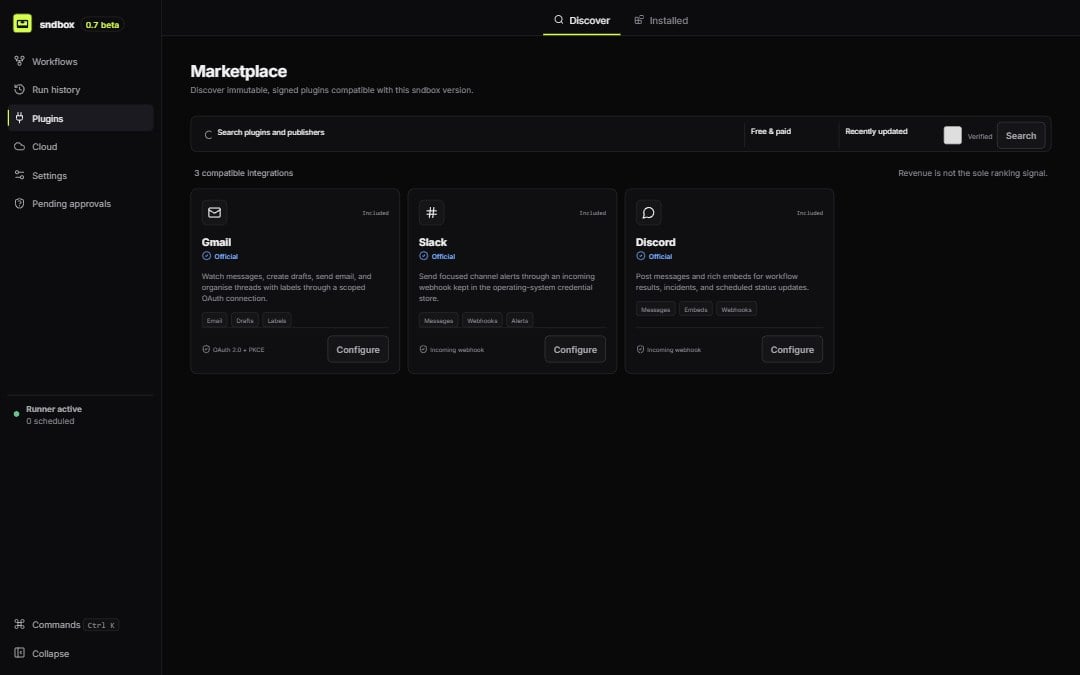
The implemented plugin marketplace and its included integrations
In the product
The Plugins area separates discovery from installed packages. Before installation, sndbox inspects identity, publisher key, archive integrity, node schemas, capabilities, network domains, credentials, storage, price metadata, and permission expansion. An installed package can be disabled, enabled after approval, updated, or revoked. Development packages carry a persistent Development label, remain disabled in production workspaces, and are excluded from exports unless explicitly included.Review before enabling
Check four layers:- Identity: publisher, signing key, repository, package version, and archive digest.
- Surface: node schemas, inputs, outputs, connection requirements, and external-effect classification.
- Capabilities: network domains, file inputs, storage, credentials, and broker calls.
- Change: new permissions, schema migrations, removed nodes, and workflows pinned to the old version.
Execution boundary
The Wasmtime host does not link general WASI, so guest code has no ambient filesystem, process, environment, or socket access. Its only import is the typedsandbox_v1::host_call broker. Every call must be declared by the plugin, referenced by the node, approved for the owner/workspace, and allowed by current policy.
The broker is enforcement, not a guarantee that a declared destination is trustworthy. Review the plugin’s data flow, response-size limits, redaction expectations, and behavior when a host call fails or is denied.
Start developing
Use the public@sandbox/plugin-sdk package and sandbox plugin CLI. The npm scope and compatibility class names keep the historical sandbox spelling, while the product and documentation use sndbox.
Create a plugin
Scaffold a Rust guest, manifest, icon, docs, and tests.
Review the manifest
Define nodes, credentials, capabilities, domains, storage, migrations, and trust.